Exploring Concepts and Practices of Entangled Histories
Date: 23 January 2026 – 10.30/16.30
Location: Van Ravensteynzaal / Utrecht University (Kromme Nieuwegracht 80)
Registration Link: https://forms.gle/M5yVq6ayqeU2Qcds5
Workshop Overview
This workshop examines the concept of entangled histories in relation to the Dutch past and its global connections from 1900 to 2025. It brings together scholars from different disciplines to explore how historical relationships—whether cultural, economic, political, legal, or material—shape and reshape one another over time. Key themes include multidirectional exchange, structures of power and inequality, colonial and postcolonial entanglements, and efforts to resist or break away from unequal connections.
Rationale
Recent historiographical developments, inspired by the spatial turn and debates on positionality and identity, have encouraged historians to move beyond national frameworks.[i] Approaches such as Transnational History, Histoire Croisée, Atlantic History, World History, and the History of Capitalism highlight the importance of interdependence, circulation, and multidirectional influence.[ii] Within this landscape, entangled history has become a crucial framework for understanding how societies, institutions, communities, and economies become intertwined—often in unequal, involuntary, or asymmetrical ways.[iii]
The Dutch case, especially in colonial and postcolonial contexts, illustrates how these entanglements persist, shift, and sometimes intensify after decolonization, raising questions about continuity, rupture, resistance, and agency.
Core Questions
The workshop addresses the following key issues:
- What defines an entangled history and how does it differ from traditional connected or comparative approaches?
- How can power asymmetries, racialized hierarchies, and forms of involuntary entanglement be identified and analysed?
- How do entanglements evolve in the postcolonial era, and how can we study continuities and transformations after formal decolonization?
- In what ways do different types of entanglements—cultural, political, legal, institutional, economic, material—shape historical interpretation?
- How can historians research resistance, agency, and attempts at disentanglement?
- Which methods, concepts, and sources help capture these multidimensional relationships?
Program
10.30-10.45 Welcome by Bram Bouwens
10.45-11.15 Panel Speaker: Elise van Nederveen Meerkerk, Professor Economic and Social History at Utrecht University. She currently leads the ERC Consolidator project Race to the bottom? Family labour, household livelihood and consumption in the relocation of global cotton manufacturing., which studies the role of production and consumption by households in the global relocation of textile production between ca. 1780 and 1990.
11.15-11.45 Panel Speaker: Pim de Zwart, Associate Professor Economic and Environmental History at Wageningen University. He was recently awarded a VIDI grant for his project Tragedy of the Tropics: Colonialism, Commodities and Commons in Southeast Asian Deforestation since 1850. In this project, long-run deforestation rates in insular Southeast Asia are reconstructed from colonial-era vegetation and topographic maps and statistical materials.
11.45-12.15 Panel Speaker: Frank Veraart, Assistant Professor History of Technology and Transition studies at Eindhoven University of Technology. He is the coordinator of the NWO project Sustainability Trade-offs in the Netherlands’ Entangled Modernization (STONEM) – 1900-2020,which looks at how commodification of natural resources contributed to the emergence of industrial global resource supply chains, and what sustainability trade-offs this process generated between the Netherlands and Global South regions.
12.30-13.30 Lunch
13.30-15.00 Workshop 3 x 30 minutes (world café)
Table 1: Methods | Table 2: Sources | Table 3: Cases
15.00-15.30 Summary by the chairs of each table
15.00-16.30 Reflection and feedback from panel speakers and open discussion
16.30 Drinks
[i] Jon Anderson, “Spatial Turn,” in The Encyclopedia of Human Geography (Springer, Cham, 2025), https://doi.org/10.1007/978-3-031-25900-5_185-2.
[ii] Bauck Sönke and Thomas Maier, “Entangled History,” InterAmerican Wiki: Terms – Concepts – Critical Perspectives, 2015, https://www.uni-bielefeld.de/einrichtungen/cias/publikationen/wiki/e/entangled-history.xml.
[iii] Terri A. Hasseler and Paula M. Krebs, “Losing Our Way after the Imperial Turn: Charting Academic Uses of the Postcolonial,” in After the Imperial Turn : Thinking with and through the Nation, ed. Antoinette Burton (Duke University Press, 2020), http://dx.doi.org/10.1515/9780822384397-007.
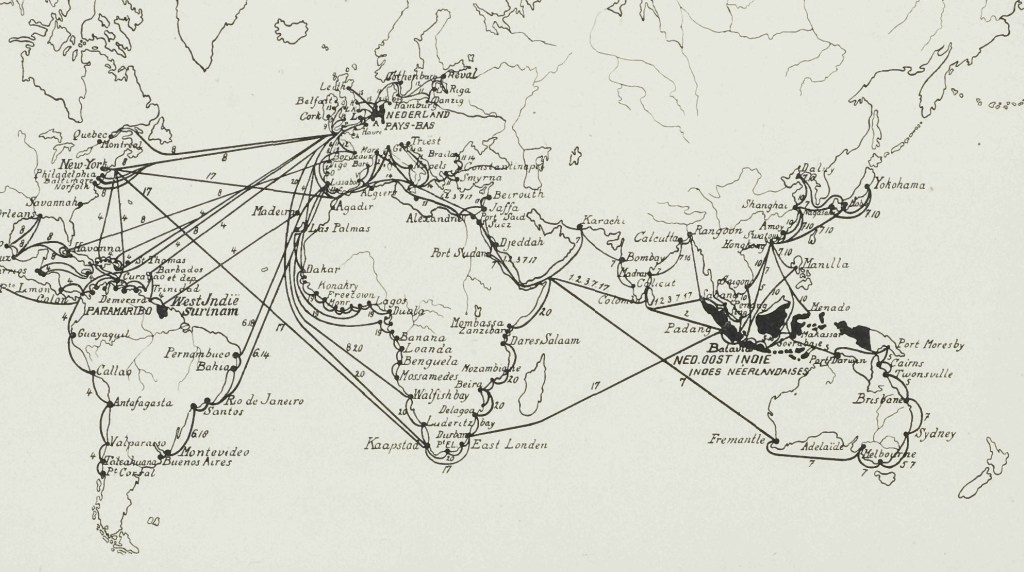
Illustration: Jaarcijfers voor Nederland 1924 [via Historisch CBS]
 STONEM